Is It Possible to Build an Artificial Life From Literally Nothing?
What would it take for an AI to learn the way a baby does?
Not fine-tuning. Not more data. Starting from zero, with nothing preloaded, and figuring out the world the slow way: by living in it.
That’s the experiment behind Mich, my personal research project. Mich is a virtual creature that starts out as a literal baby. It doesn’t know what a ball is, what a human is, or even what binary is. All of that has to be discovered, not downloaded.
Note: This is a devblog, not a paper. I’m documenting what I’m trying to build, what I’ve learned, and where it might fail.
What Is the Scope of Mich?
I want to build Mich from literally nothing.
- No AI model provider.
- No LLM.
- No pretrained intelligence.
Just a pile of small, biologically inspired mechanisms, and the hope that complex behavior comes out of how they interact.
People call this bottom-up AI: start small and let intelligence grow, instead of starting with a big model and strapping a body onto it. It’s a niche. Documentation is thin compared to the mainstream, and after about three months of work the progress is still small. But it keeps moving, and Mich is my case study.
How Mich Works
Mich’s brain is a 16×16 grid of simulated neurons, 256 cells in total. Tiny by any standard. The interesting part isn’t the size though; it’s the rules the cells follow.
Learning: Hebbian + STDP
Neurons connect to each other, and the connections change with use:
- Hebbian learning: neurons that fire together, wire together. Two neurons that activate at the same time get a stronger link. It’s like a path across a field: walk it often enough, and it turns into a road.
- STDP (spike-timing-dependent plasticity) is the timing version. A connection only strengthens when neuron A fires before neuron B, cause before effect. Think of a lesson that only sticks when the teacher explains first.
The surrounding systems
On top of that substrate sit five biologically inspired systems. Alone, each one is trivial. Together, they’re supposed to add up to something that acts like a mind.
- A six-hormone neurochemical regulatory system. Six simulated chemical messengers nudge how the brain reacts to the same input. Same question, different answer, depending on whether you’re rested or running on fumes.
- Place-cell spatial memory with object permanence. Some neurons act as pins on a mental map, and Mich learns that objects outlive their visual field. The ball still exists behind the wall, the way your keys still exist in the drawer.
- Circadian homeostasis. An internal clock builds sleep pressure, then resets it. Mich gets sleepy, sleeps, wakes up fresh. Just like you.
- A curiosity engine. Mich keeps predicting what it expects to see next. When reality misses the prediction, that gap is a small reward signal, and exploring becomes worth it. It’s the toy that moves strangely that a baby keeps staring at, not the toy it has seen a hundred times.
- An insular-cortex analogue for cross-modal binding. Senses get merged into single objects. “Ball” stops being three separate properties: round, red, bouncy. One thing.
Put together, the flow looks like this:
flowchart TD
    S[Body + Environment] --> P[Perception]
    P --> N[16×16 Neural Matrix]
    N --> M[Hebbian Learning + STDP]
    N --> R[Spatial Memory]
    N --> C[Curiosity / Prediction Error]

    H[Hormonal Regulation] --> N
    H --> C
    H --> B[Homeostasis]

    B --> W[Circadian / Sleep-Wake Cycle]
    R --> A[Action Selection]
    C --> A
    A --> S

    P --> I[Cross-Modal Binding]
    I --> N

    classDef env fill:#e3f2fd,stroke:#1e88e5,stroke-width:2px;
    classDef brain fill:#f3e5f5,stroke:#8e24aa,stroke-width:2px;
    classDef hormone fill:#fff3e0,stroke:#fb8c00,stroke-width:2px;

    class S env;
    class N,M,R,C,I,A brain;
    class H,B,W hormone;
What has come out of it so far
At roughly 2.3 simulated years of age (about 72 days of real operation), a few behaviors have started to appear:
- Intentional speech
- Goal-directed exploration
- Sleep-wake cyclicity
- Proto-reflective realizations, like this one:
“BALL HERE.”
The sentence itself is nothing. What gets me is the chain that might have produced it: perception of the ball, a spatial-memory match, cross-modal binding fusing shape, color, and bounce into one object, the curiosity engine flagging a prediction gap, and the speech system crossing its threshold. A whole chain of simple mechanisms, all for two words.
That’s the kind of moment that keeps this project going.
Why Am I Doing This?
LLMs are remarkable at language, but they’re also strangely weightless:
- They never start as a baby or develop along a biological trajectory.
- No body to maintain, no homeostasis. They don’t wake up because they’re hungry.
- Nothing ever violates their expectations, because nothing is expected.
Capability is not the gap. Embodiment and development are. And I want to know if those can be built from the bottom up.
What Makes This Different?
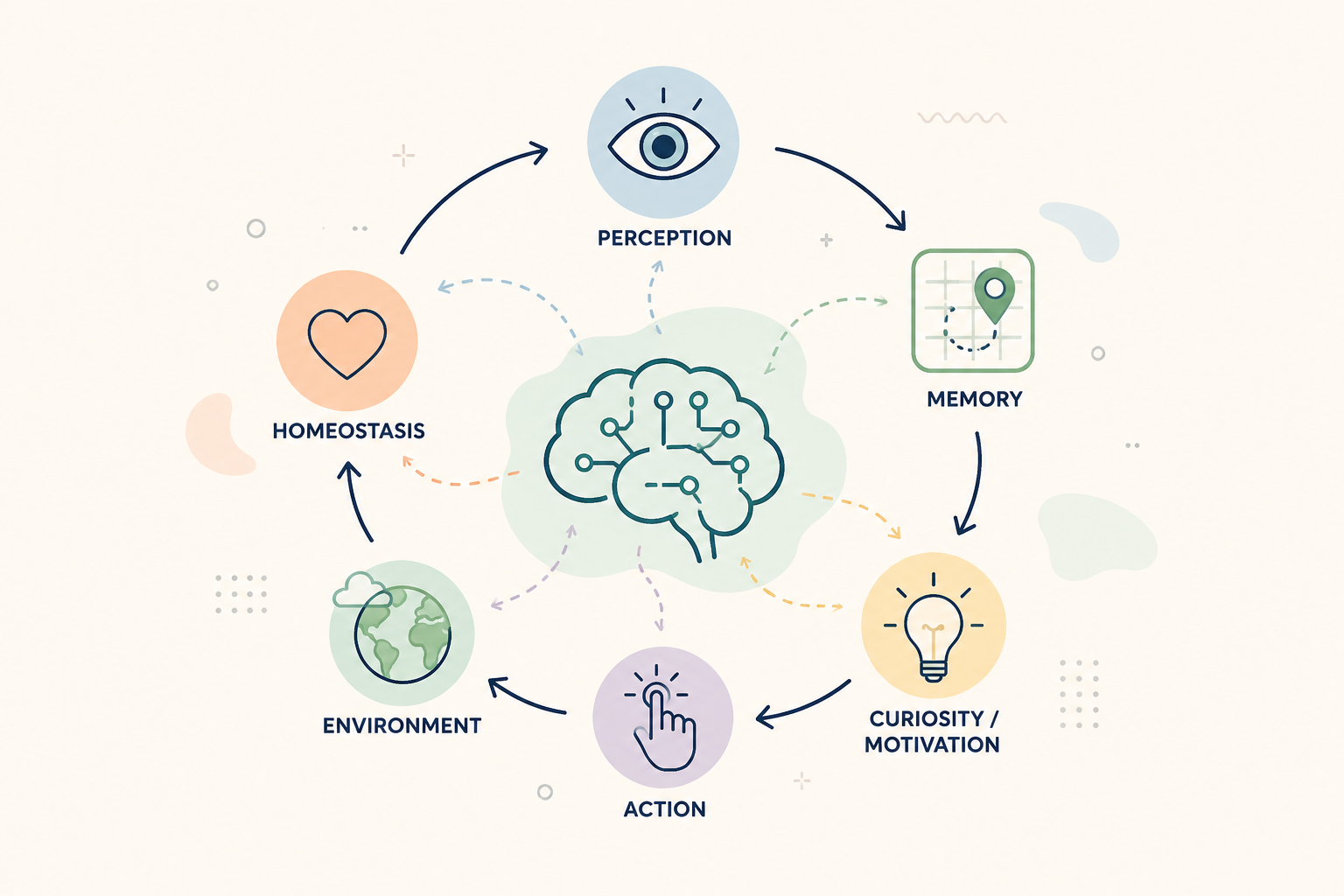
There are many ways to make an AI talk or move around. The difference here is the loop: perception → internal state → memory + prediction → motivation → action → a changed world → new perception. Simple mechanisms influencing each other, continuously.
flowchart LR
    A([Environment]) --> B(Perception)
    B --> C{Internal State}
    C --> D(Memory + Prediction)
    D --> E(Curiosity / Motivation)
    E --> F[Action]
    F --> G([Environment Changes])
    G --> H(New Perception)
    H -.->|Learning| C

    style A fill:#e8f5e9,stroke:#4caf50
    style G fill:#e8f5e9,stroke:#4caf50
    style F fill:#e3f2fd,stroke:#2196f3
    style C fill:#fff3e0,stroke:#ff9800
A creature doesn’t need to understand everything to start learning. It just needs to keep touching something outside itself.
That’s why the real question isn’t “can I make an AI say ‘ball’?”. It’s “can I build a system where ‘ball’ becomes meaningful because the system has interacted with the world?”
Current Feasibility
Honest status: nowhere close to biological intelligence.
The bottleneck is the substrate: a feedforward 16×16 matrix with 8-bit encoding. 256 neurons, one-way connections, and every signal quantized to 256 levels. For scale, that’s fewer cells than a roundworm has (302). I suspect this is where development stops scaling, no matter how good the architecture on top is.
So the real questions are:
“How far can a very small biologically inspired system actually go?”
And:
“At what point does increasing complexity stop producing meaningful emergence and simply become a different kind of engineered AI?”
No answers yet. It’s also part of why I keep writing these posts.
The Ideas Behind Mich
This research leans on a few older traditions:
- Synthetic Psychology by Valentino Braitenberg (1984)
- Subsumption Architecture by Rodney Brooks (1986)
- Free Energy Principle by Karl Friston (2005)
- Thousand Brains Theory by Jeff Hawkins (2021)
I’m not claiming Mich implements these theories. They’re reference points. The view they share is that consciousness might not be a computational problem you solve directly; it may be something that shows up once a system gets complex, adaptive, and homeostatic enough. I want to see what actually happens when ideas like these get built instead of discussed.
So… Is It Possible?
I genuinely don’t know. That’s the honest answer, and honestly the interesting one.
Mich isn’t here to prove artificial life is done. It’s an experiment in how far a creature that starts with almost nothing can get by interacting, remembering, regulating, and learning.
Maybe it comes surprisingly close to something real. Maybe it hits a hard architectural ceiling. Maybe the whole thing fails. All three outcomes teach me something.
For now, Mich is just beginning. This is #1; more devnotes, experiments, failures, and weird behaviors will follow.
See you in the next one.
References
For this first post, the references are intentionally limited to the works mentioned above:
- Braitenberg, V. (1984). Vehicles: Experiments in Synthetic Psychology.
- Brooks, R. A. (1986). A Robust Layered Control System for a Mobile Robot.
- Friston, K. (2005). A theory of cortical responses.
- Hawkins, J. (2021). A Thousand Brains: A New Theory of Intelligence.